How to Keep a Stress Journal That Shows Your Patterns

A stress journal is a short, repeatable log of how stressed you were and what was going on, kept specifically so you can look back and see what repeats. It isn’t a diary, and the writing part matters less than most people expect. The point is the looking back.
I build a stress tracking app, so take my enthusiasm with the appropriate pinch of salt. But the part worth your attention isn’t the app. It’s that almost everyone who tries this quits before the only step that pays off, which is reading their own entries a few weeks later.
What is a stress journal, and how is it different from a regular journal?
A regular journal is for the writing. You’re thinking something through, and the value lands as you write it.
A stress journal is for the reading. Each entry is small on purpose, because the entry isn’t the product. Thirty entries are the product. You want them short enough that you’ll still be making them in week six, and structured enough that you can scan a month without rereading prose.
That difference drives everything else:
- Short beats expressive. A number and a sentence beats three paragraphs, because you’ll actually do it on a bad day.
- Same fields every time. Consistency is what makes a stack of entries comparable. Changing your format every fortnight gives you a pile of incomparable notes.
- Logged in the moment, where you can. Stress logged at 6pm is stress remembered. By then the specifics have flattened into “today was a lot.”
If you want the broader daily-check-in version, which covers mood, sleep, and energy as well, that’s a wellness journal, and it’s a different tool with a bigger surface. A stress journal is the narrow one.
What should each entry include?
Four fields is plenty. Three if you want it faster.
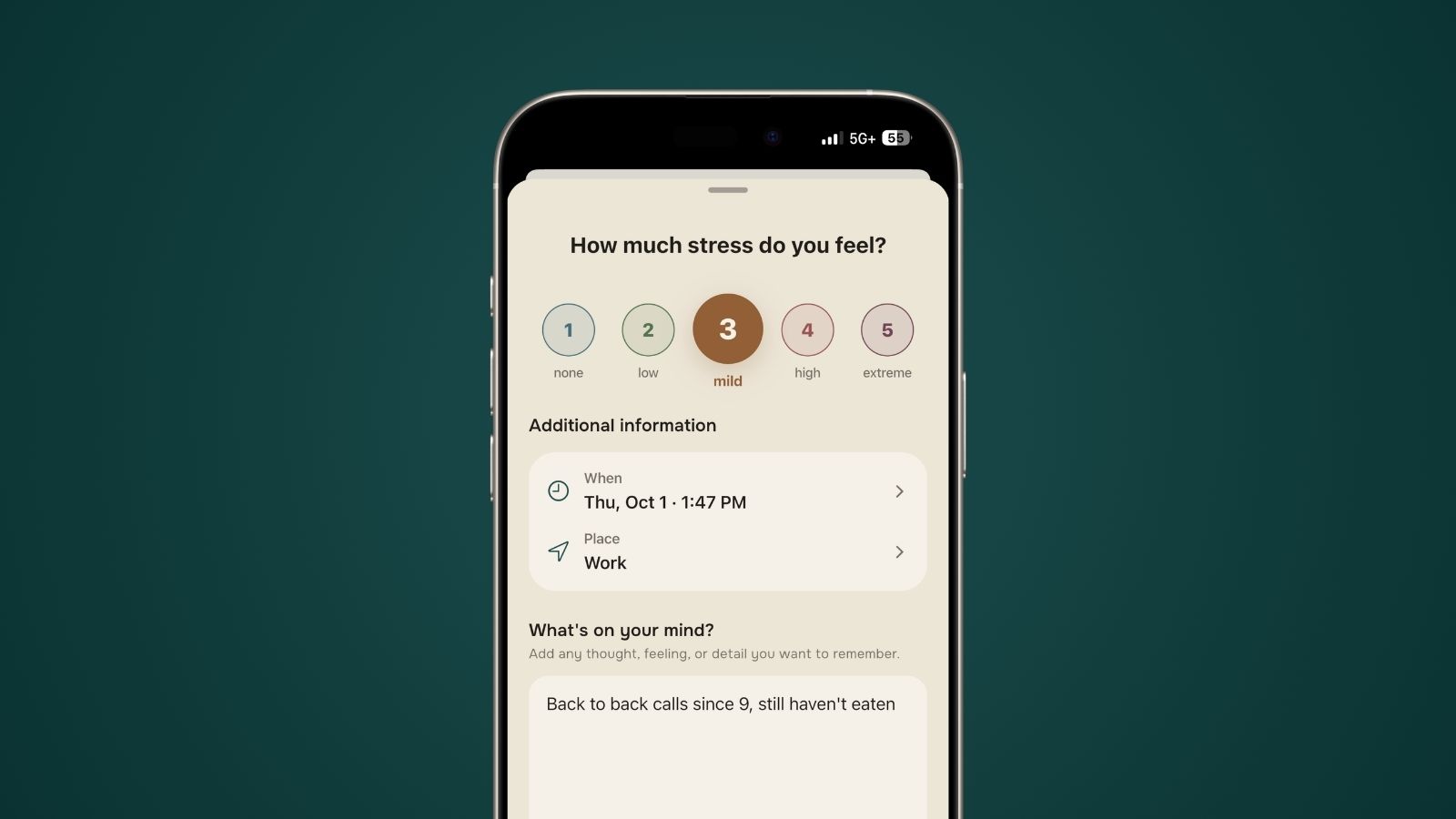
- A stress level, on a 1 to 5 scale.
- What was happening. One line. Where you were, who was involved, what had just occurred.
- The time. Most logging tools do this for you, and it matters more than it looks: time of day is one of the patterns most likely to surface.
- What you did about it, if anything. Optional, and the field that eventually tells you which responses actually work for you.
That’s it. Resist adding more. Every extra field is a small tax you pay on your worst days, and your worst days are exactly the entries you most need.
Why 1 to 5 and not 1 to 10
This is a design decision I’ve thought about more than is reasonable, so here’s the reasoning.
On a 1 to 10 scale, 7 becomes the default. It’s the comfortable mid-high answer that means almost nothing, and most people’s logs end up clustered there. Worse, the fine gradations are fake. What honestly separates a 3 from a 4 out of 10? You’re putting a number on a feeling that has no native numeric value, so the precision is invented either way.
Five options gives you something you can answer accurately: 3 is mid, 4 is more than that, 5 is the most, and the same going down. You can pick that in a second while you’re actually stressed, which is the only time it matters. A bigger scale looks more scientific and gives you less.
Why the number comes before the reason
In Stress Less the level is the first thing you tap, and the note is optional. That ordering is deliberate.
Sometimes you’re at a 5 and you don’t want to write about it, you want something that helps right now. That’s a completely valid use. Sometimes you’re at a 2 and faintly bored and just want something to occupy your head for a minute. Also valid. Requiring an explanation before you can log is how you teach people to skip logging on the days that matter most.
The goal is to meet you where you are and let you share as much or as little as you want. Understanding yourself is the point, and you don’t owe an app an essay to get there.
Does journaling actually reduce stress?
Honestly: the evidence is real, older than most wellness advice, and more qualified than it’s usually presented. All three of those are worth knowing.
The strongest work is on expressive writing, which James Pennebaker started in the 1980s. The APA’s summary of that research describes a 1988 study where undergraduates wrote about either traumatic experiences or superficial topics for four days. Six weeks later the trauma group reported better moods and fewer illnesses, with measurably better immune function.
Now the qualifications. A 2023 review of 24 randomized trials found benefits depend heavily on who is writing and how, and that writing interventions showed no clear advantage for depression, anxiety, or stress taken individually. The APA’s own coverage adds that venting alone doesn’t do the work: people who relive an upsetting event without finding meaning in it report worse health than people who write toward some understanding of it.
There’s a similar wrinkle in naming feelings. Putting a feeling into words is called affect labeling, and a 2022 study found it reduced distress when the feeling was intense and slightly increased it when the feeling was mild.
Which lands somewhere more useful than “journaling reduces stress.” On a bad day, writing out what’s happening is likely to help. On an ordinary Tuesday, skip the introspection and just log the number. The number is what the pattern is made of anyway.
What is a stress score, and how is it calculated from check-ins?
A stress score compresses a stretch of check-ins into one number so you can see movement. Most apps keep the formula vague. Since I wrote ours, here is exactly what it does.
In Stress Less the score runs 0 to 100, where lower is calmer, over the last 7 local calendar days, and it’s computed on your phone from your own check-ins.
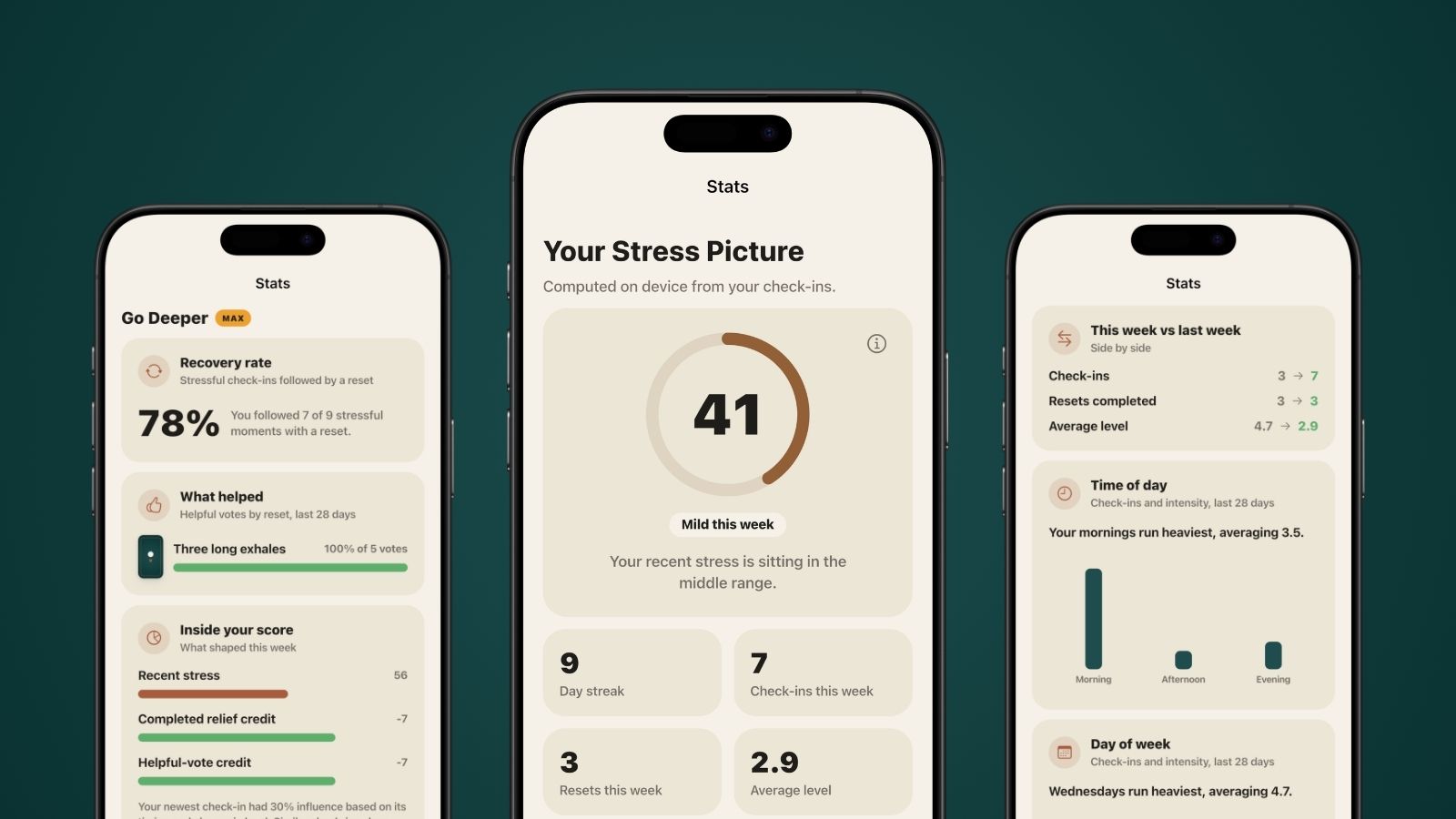
Each level has a target. A 1 points at 0, 2 at 25, 3 at 50, 4 at 75, and 5 at 100. The bands are Calm for 0 to 20, Low for 21 to 40, Mild for 41 to 60, High for 61 to 80, and Extreme for 81 to 100.
It is not an average. This is the part that matters. The score is a running value, and each new check-in pulls it toward that check-in’s target by a fraction of the remaining distance. The oldest check-in in the window sets the starting point, and everything after nudges it.
How big a nudge depends on two things, and the larger one wins:
- Time since your last check-in. An hour or less moves it about 5 percent of the remaining gap. Four hours or more moves it 30 percent, with a straight ramp in between.
- How much the level changed. A one level jump is worth about 13 percent, two levels about 22, three or more about 30.
So a 5 logged four hours after a 2 moves the score hard, and a second 5 logged twenty minutes later barely moves it at all. That’s intentional. An average would treat those two check-ins as equally important, which doesn’t match how the day actually went.
Three guards stop it going haywire:
- Burst damping. The third and later check-ins at the same level within an hour count for 2 percent. Logging “5” five times in a row doesn’t produce a worse score than logging it twice.
- A movement cap. No single check-in can move the score more than 25 points.
- An early read flag. Below 5 check-ins across at least 3 different days, the score is labeled an early read. It’s calculated the same way; the label just tells you there isn’t much behind it yet.
Relief counts too. Completing a reset takes up to 5 points off, and marking it helpful takes off up to another 5, capped at 20 points total. Those credits halve every 2 days, so relief you did last week stops flattering today’s number. Skipped resets and thumbs-down votes don’t count. Neither do notes, location, streak, or how many times you’ve checked in.
A worked example, since it’s easier to see than describe:
- Monday, you log a 2. The score starts at 25.
- Tuesday, more than four hours later, you log a 5. Big jump, long gap, so it moves 30 percent of the way from 25 to 100, landing around 48.
- Twenty minutes later, another 5. Only 5 percent now, so it edges to about 50.
- You do a reset and mark it helpful. 10 points off, so the score reads 40, which is Low.
- Two days pass with nothing logged. The credit has halved, so the score drifts to 45, which is Mild.
One quirk worth knowing, because it looks like a bug otherwise: the window rolls at local midnight, and when the oldest check-in ages out the next-oldest becomes the new starting point. Your score can shift overnight without you doing anything.
What it isn’t. It isn’t a clinical measure, it isn’t comparable to anyone else’s, and it isn’t a target to get down. It’s a way to notice that this fortnight is running hotter than the last one, which is hard to see from inside.
My own sits in the 40s most of the time, which is Mild. I’d love to show you a tidy twelve month trend, but I wipe my data constantly because I’m testing the thing, so my own history is more sawtooth than story.
Journal or tracking app: which should I use?
Paper wins on one thing and loses on another.
Paper or a notes app is better for thinking. There’s no friction of someone else’s format, and writing by hand suits the days where you need to work something out rather than record it. The cost is that reviewing is manual. You will be flipping pages and squinting at a month, and this is the step where most people quietly stop.
A tracking app is better for the looking back, because the numbers are already comparable and the chart is already drawn. The cost is that it shapes what you record. You answer its fields.
A reasonable split: use an app for the daily number and the one-line note, and keep paper for the occasional longer write when something needs thinking through rather than logging. They’re not competing, and the research above suggests they do different jobs.
If you’d rather build the habit from scratch before committing to a tool, how to start a wellness journal covers the habit mechanics, which are the actual hard part.
How do I turn entries into patterns?
A few weeks in, you have a stack. Here’s how to read it.
- Sort by day of week, not by date. Group every Monday, every Tuesday. Work patterns in particular surface here and almost nowhere else.
- Look at time of day. If you have timestamps, this is the cheapest insight available. Most people have a reliable worst hour and no idea what it is.
- Read your notes for repeated words. Not analysis, just scanning. The same name, place, or task showing up in your worst entries is the finding.
- Check what happened the day before. Some stress is yesterday’s bill. Poor sleep, a skipped meal, a conversation left open.
- Make one prediction. Guess next week’s shape before you log it. If you’re right, you’ve found something real. If you’re wrong, you’ve learned your model is off, which is also progress.
Be realistic about resolution. If you check in once a day, your log can tell you which days were bad and what you wrote beside them. It won’t reconstruct the order of events inside one bad afternoon, and any tool claiming otherwise is overselling. Day-level patterns are where the useful findings live anyway, and that’s covered in depth in how to spot your stress patterns and how to find your stress triggers.
Stress Less does the mechanical part of this: check in on a 1 to 5 scale in seconds, add a line if you want one, and the history, stats, and score are there when you sit down to look. On Stress Less Max, the app also generates AI insights on your device whenever it finds a pattern in your logs, and shows the score broken into its parts so you can see what moved it. Everything stays on your phone, and the score comes from what you type in, not from a sensor or a watch.
Stress Less is available now on the App Store.
Related reading
- What Is a Wellness Journal? A Daily Practice for Less Stress
- How to Start a Wellness Journal You’ll Actually Keep
- How to Find Your Stress Triggers and What to Do About Them
- How to Spot Your Stress Patterns and Use Them
Written by Dave Faliskie, with AI assistance for research and editing.
Stress less, one check-in at a time
Track what’s weighing on you, get a quick relief action, and start noticing the patterns behind your stress.

More from the blog

How to Manage Stress at Work: What Actually Helps
Nearly half of US workers feel tense during the workday. Here's what causes work stress, what helps in the moment, and when it's more than stress.

Beat the Sunday Scaries: 7 Small Resets That Actually Work
The Sunday Scaries are real and predictable. Here are 7 small resets that quiet the dread before Monday, plus what's behind that Sunday-night knot.

Teacher Stress Management: A Practical Guide for Long Days
Practical stress management for teachers, grounded in what the research shows. What helps during the school day, across the week, and over a full school year.